Fractal landscapes in games and film
Fractal mountains in films and games are grown, not modelled: midpoint displacement, Perlin noise and octaves of detail, and why the results look natural.
Look closely at almost any mountain range in a film or a video game made since the 1980s and there is a good chance it was never modelled by hand. It was grown by a short algorithm that adds detail on top of detail, each layer smaller and fainter than the one before. That recipe is fractal geometry in its most practical form, and it changed computer graphics so thoroughly that today it is simply part of the toolkit.
This article follows the idea from its first experiments to the endless worlds of modern games: how midpoint displacement works, why Perlin noise won an Academy Award, how “octaves” of noise build a mountain, and why the results look so convincingly natural.
From Brownian motion to mountains
Benoit Mandelbrot argued in the 1970s that real coastlines and relief are statistically self-similar: zoom into a ridge and you see smaller ridges with the same kind of roughness. In The Fractal Geometry of Nature (1982) he showed computer-made landscapes, many produced with Richard Voss, built from fractional Brownian motion – a random function whose ups and downs look alike at every scale (see Lesson 14).
The roughness of such a function is controlled by a single number, the Hurst exponent H, between 0 and 1. A small H gives a jagged, nervous profile; a value near 1 gives gently rolling hills. For a surface, the fractal dimension is D = 3 − H. Measurements of real terrain often give estimates around D ≈ 2.2–2.3 (values vary with region, scale and method), which corresponds to H of about 0.7–0.8. That is the range graphics programmers learned to aim for.
Midpoint displacement and the first fractal films
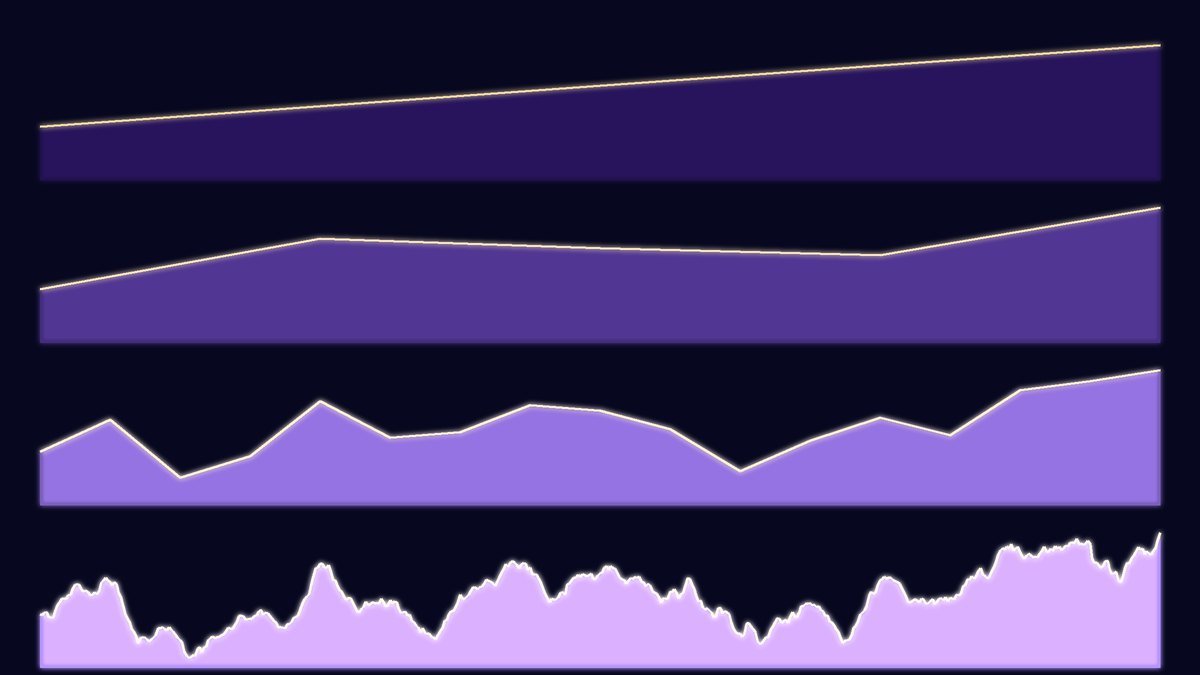
Mandelbrot and Voss used spectral methods that were slow on the computers of the time. A much cheaper trick was published in 1982 by Alain Fournier, Don Fussell and Loren Carpenter. In one dimension it goes like this:
- Start with a straight line between two endpoints – a single slope.
- Take the midpoint and move it up or down by a random amount.
- You now have two segments. Displace the midpoint of each one, but with a smaller random range.
- Repeat, shrinking the random range by a fixed factor each round – by 2−H for a profile with Hurst exponent H.
After about ten rounds the line has over a thousand segments and looks remarkably like a mountain skyline. Large early displacements set the main peaks; later, tiny ones add the crags.
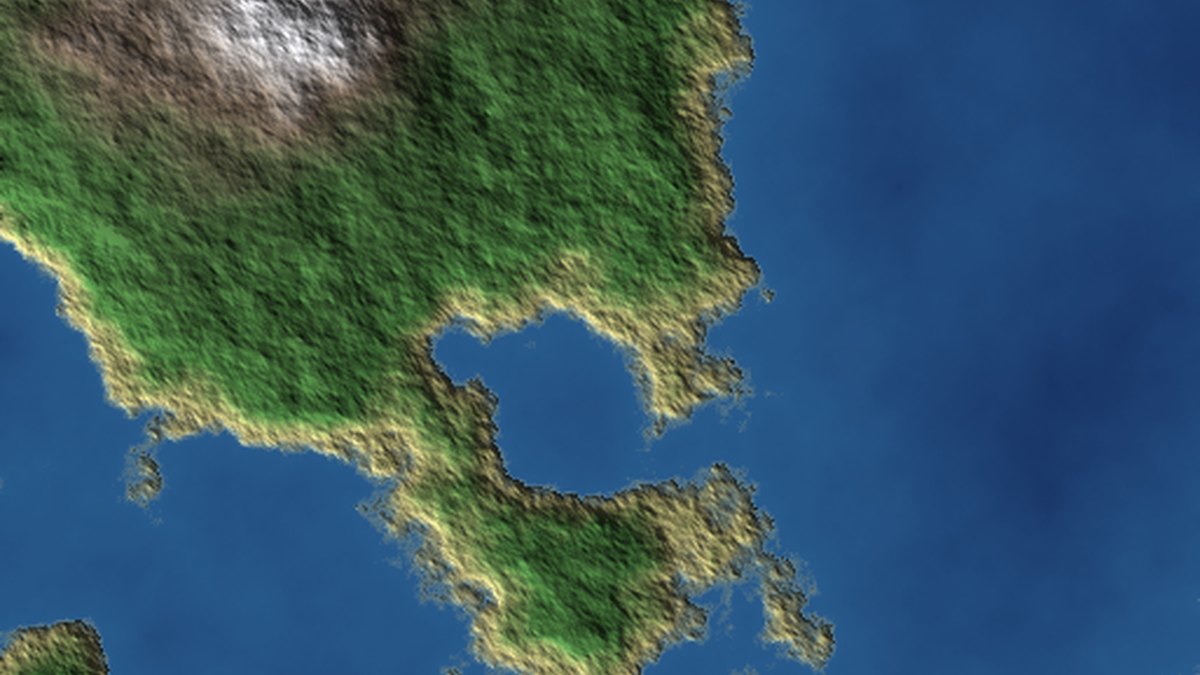
In two dimensions the same idea works on a grid of heights. The best-known version is the diamond-square algorithm: in the “diamond” step, the centre of each square gets the average of its four corners plus a random offset; in the “square” step, the midpoint of each edge gets the average of its neighbours plus an offset. Halve the step, shrink the randomness, repeat. Diamond-square is fast and easy to code, though it tends to leave faint creases along the grid lines – one reason later methods replaced it.
Vol Libre and the Genesis sequence
Loren Carpenter, then working at Boeing, became the public face of this technique. In 1980 he showed a short film called Vol Libre at the SIGGRAPH computer graphics conference: a flight through fractal mountains generated by subdividing triangles. Carpenter was soon hired by Lucasfilm’s computer graphics group.
There he worked on the “Genesis sequence” for Star Trek II: The Wrath of Khan (1982), a minute-long shot in which a dead planet is transformed into a living world. Its fractal mountains, together with particle effects for the spreading fire, made it one of the landmark computer-generated sequences in a feature film. The same group later became Pixar.
Perlin noise and fractal Brownian motion
While working on Tron (1982), Ken Perlin grew frustrated with how clean and “machine-like” computer images looked. His answer, published in 1985, was a new kind of smooth random function now called Perlin noise. Instead of displacing points one by one, it assigns random gradients to the points of a lattice and blends between them with a smooth curve. The result is a field of gentle bumps of roughly one size, with no seams, that can be evaluated at any point in space without storing a grid. In 1997 Perlin received an Academy Award for Technical Achievement for this work.
One layer of Perlin noise is not fractal: its bumps have a typical size. The fractal part comes from adding several layers, called octaves:
- Lacunarity – how much the frequency grows from one octave to the next, usually 2, so each layer has bumps half as wide.
- Persistence or gain – how much the amplitude shrinks per octave, often 0.5, so each layer is half as tall.
- The number of octaves – typically 4 to 10, until the details are smaller than a pixel.
The sum is usually called fBm, after fractional Brownian motion, and it is statistically self-similar over the range of octaves used. The two knobs are linked to the Hurst exponent: with lacunarity L and gain G, the profile behaves like fBm with G = L−H. With L = 2, a gain of 0.5 gives H = 1 (smooth), while a gain closer to 0.6 gives rougher, more mountain-like terrain. Artists also bend the recipe: taking the absolute value of each octave and inverting it gives sharp “ridged” crests, and making the gain depend on height lets valleys stay smooth while peaks stay rough – surfaces sometimes described as multifractal (see Lesson 19).
Procedural worlds: Minecraft and No Man’s Sky
Games took these methods further because they solve a storage problem. A noise function needs only a seed number and a formula; the terrain at any location can be computed on demand. That is why a sandbox game like Minecraft can offer a world that is, for practical purposes, endless: its terrain generator combines several layers of noise to decide height, caves, biomes and the placement of features, and the same seed always gives the same world.
No Man’s Sky (2016) pushed the idea to a galaxy of procedurally generated planets. Its developers have described a system built on layered noise functions, with many tweaks, that shapes each planet from a seed rather than storing it. The details of commercial engines are rarely published in full, but the principle is the same: fractal noise for the big shapes, hand-made rules on top for gameplay and style.
Plants are often handled by a related fractal tool. L-systems, introduced by the biologist Aristid Lindenmayer in 1968, rewrite a short string of symbols again and again – “grow a segment, branch left, branch right” – and the result is drawn as a tree, a fern or a bush (see Lesson 13 and the interactive trees). Combined with fractal terrain, they let a small program cover a hillside with forest.
Why it works – and where it does not
Fractal terrain convinces the eye because real landscapes are shaped by processes, such as erosion, uplift and fracture, that act over a wide range of scales. The statistical match between fBm and real relief is good enough that our visual system accepts it. But it is only a statistical match. Pure fBm has no rivers flowing downhill, no consistent drainage network, and every region looks equally rough, while real mountains are rough at the top and smooth in the valleys where sediment collects. Modern tools therefore combine fractal noise with simulations of hydraulic and thermal erosion, which carve channels and deposit fans that noise alone cannot produce.
Try it yourself
Start with Lesson 14 on random fractals to see Brownian motion and the Hurst exponent in more detail, then read How to draw fractals with Python and try writing a one-dimensional midpoint displacement yourself – it takes about a dozen lines. For the real landscapes that these algorithms imitate, visit fractals in nature.