Penrose tilings and quasicrystals
How Penrose tiles cover the plane without ever repeating, why their self-similarity involves φ, and how quasicrystals brought the idea into real matter.
A bathroom floor of square tiles repeats perfectly: shift it by one tile and it lands exactly on itself. For centuries mathematicians and crystallographers assumed that order in a pattern and repetition in a pattern were more or less the same thing. Penrose tilings broke that assumption on paper in the 1970s, and quasicrystals broke it in real matter in the 1980s, earning a Nobel Prize along the way.
These patterns are closely related to fractals through self-similarity, but they are not fractals in the usual sense. Seeing exactly where the connection holds and where it stops is a good way to sharpen what “fractal” means.
Periodic and aperiodic tilings
A tiling covers the plane with shapes, without gaps or overlaps. It is periodic if you can slide it in two different directions so that it matches itself exactly, like squares, hexagons or a brick wall. Periodic tilings can have only certain rotational symmetries: 2-, 3-, 4- or 6-fold. Fivefold symmetry is impossible – you cannot tile a floor with regular pentagons – a fact known as the crystallographic restriction.
A set of tiles is aperiodic if it can tile the plane but only non-periodically. Whether such sets exist was a real question. In the 1960s Robert Berger showed that they do, but his first set needed more than 20,000 different square tiles with matching rules on their edges. Later work reduced the number, and the race for a small set reached its most famous result with Roger Penrose.
Penrose’s tiles
Around 1974 Roger Penrose, the Oxford mathematical physicist, found aperiodic sets of just two tiles. The best-known versions are:
- Kites and darts (often called P2): two quadrilaterals cut from a rhombus with angles of 72° and 108°.
- Thick and thin rhombs (P3): two rhombi with equal sides, one with angles of 72° and 108°, the other with 36° and 144°.
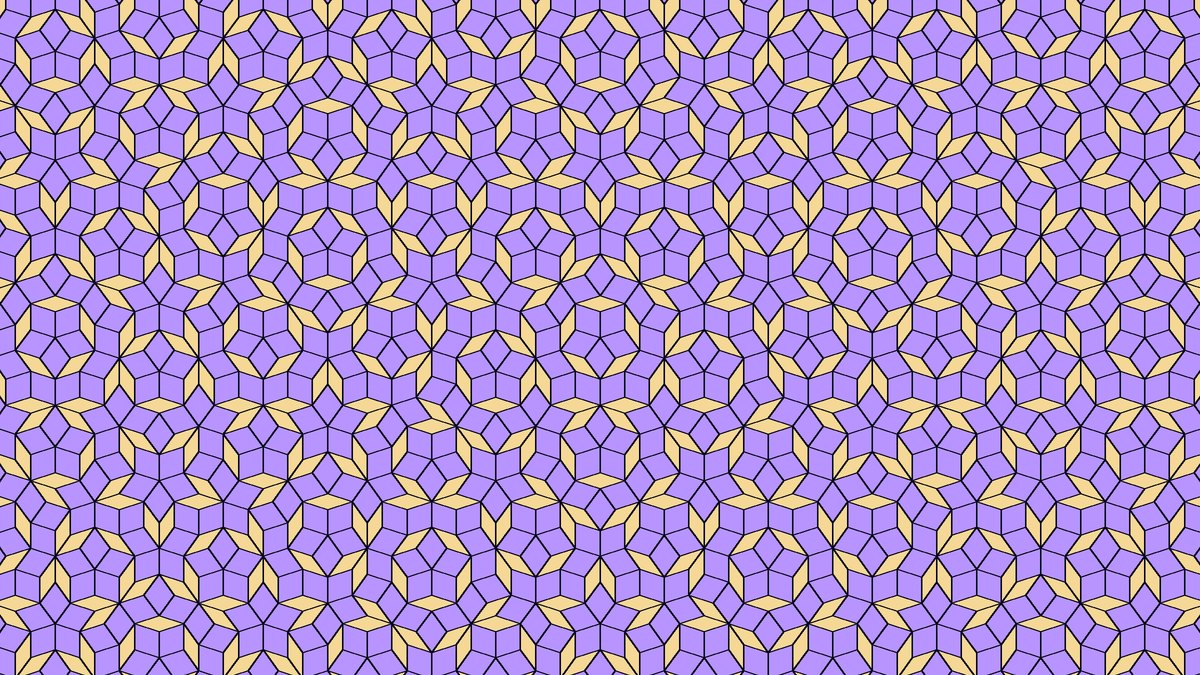
On their own, two rhombi could easily tile periodically, so Penrose added matching rules – markings or notches on the edges that must line up. With the rules, every tiling is non-periodic. Yet it is far from random: it is full of local fivefold stars and decagons, and any finite patch you see appears again, infinitely often, all over the plane.
Inflation, deflation and the golden ratio
The deepest property of Penrose tilings is self-similarity under substitution. Each thick or thin rhomb can be cut into smaller thick and thin rhombs in a fixed way, a step called deflation. The smaller tiles are scaled down by the golden ratio φ = (1 + √5)/2 ≈ 1.618, and after rescaling, the new tiling is again a legal Penrose tiling. The reverse step, inflation, glues tiles into larger ones. Repeating deflation is also a practical way to draw a Penrose tiling, which is how the figure above was made.
The golden ratio shows up in the counts too. In the rhomb version, one deflation turns each thick rhomb into two thick and one thin rhomb (counting the pieces of half-tiles appropriately), and each thin rhomb into one thick and one thin. If you start with any patch and deflate again and again, the ratio of thick to thin rhombs approaches φ. Because φ is irrational, the pattern can never settle into a repeating unit – a neat way to see why it must be non-periodic. (For more on the golden ratio and what it does and does not have to do with fractals, see Fractals and the golden ratio.)
Self-similar, but not a fractal
This is where the distinction matters. A fractal like the Koch curve is a rough set of points whose fractal dimension exceeds its topological dimension: D = log 4 / log 3 ≈ 1.262 for a curve. A Penrose tiling is different:
- The tiles simply fill the plane, so the covered region has dimension 2, and the tile edges are ordinary straight segments of dimension 1.
- The self-similarity belongs to the arrangement of the tiles, not to the roughness of any boundary. Zooming in on one tile reveals nothing new – just a smooth rhombus.
- Only by applying deflation as a rule, scale after scale, do you see the same pattern repeating hierarchically.
So Penrose tilings share with fractals the idea of a structure built from smaller copies of itself (see self-similarity), but they are tilings with hierarchical order, not fractal sets. Some related constructions do produce genuinely fractal boundaries – for instance, certain substitution tilings whose tiles have fractal edges – but the classic Penrose tiles are not among them.
Quasicrystals: Shechtman’s forbidden symmetry
On 8 April 1982, Dan Shechtman, working at what was then the US National Bureau of Standards, examined a rapidly cooled alloy of aluminium and manganese with an electron microscope. Its diffraction pattern – the spots produced when electrons scatter from the atoms – showed sharp points arranged with tenfold symmetry. Sharp spots mean long-range order; tenfold symmetry was supposed to be impossible for a crystal, by the same crystallographic restriction that forbids pentagon tilings.
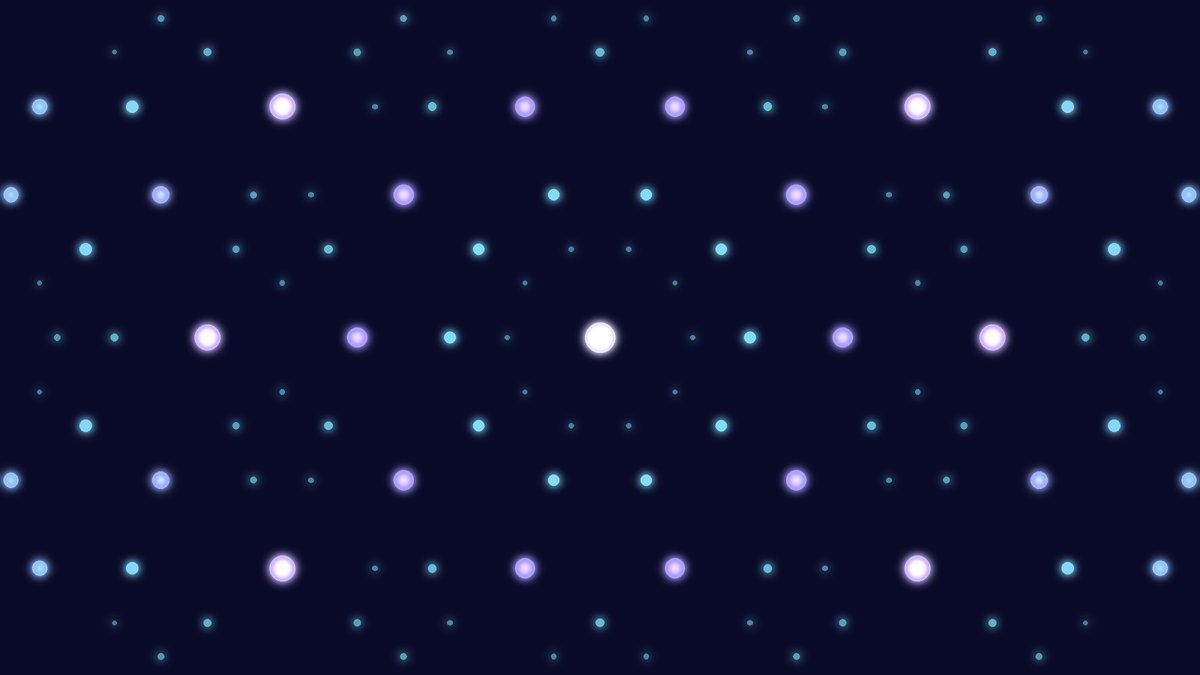
Shechtman’s result, published in 1984, met strong resistance; the double Nobel laureate Linus Pauling was among the prominent sceptics, proposing that the patterns came from twinned ordinary crystals. But other groups reproduced the findings, and physicists including Dov Levine and Paul Steinhardt showed that three-dimensional analogues of Penrose tilings would produce exactly such diffraction. The new materials were named quasicrystals, and in 1992 the International Union of Crystallography broadened its definition of a crystal to any solid with an essentially discrete diffraction pattern. Shechtman received the 2011 Nobel Prize in Chemistry. Natural quasicrystals were later found in a meteorite fragment from Russia’s Khatyrka region.
The hat and the girih
Penrose needed two tiles. Could one tile be enough? This “einstein problem” (from German ein Stein, one stone) stayed open for decades. In 2023 David Smith, an amateur shape enthusiast, together with Joseph Samuel Myers, Craig Kaplan and Chaim Goodman-Strauss, announced the hat: a single 13-sided polygon that tiles the plane only non-periodically. Its tilings use the hat together with its mirror image; within months the same team found the spectre, a related tile that works without reflections.
A different story looks backwards. In 2007 Peter Lu and Paul Steinhardt proposed that some medieval Islamic artisans decorated buildings using a set of girih tiles – decorated polygons whose lines form the familiar strapwork – and that certain patterns, notably on the Darb-i Imam shrine in Isfahan (1453), show self-similar subdivision and an arrangement close to a Penrose pattern. Most Islamic geometric art is periodic, and the proposal concerns how some designs may have been constructed, not a claim that artisans knew modern aperiodic theory. It remains an interpretation, though a widely discussed one.
Where to go next
To compare hierarchical tilings with true fractals, read about self-similarity and fractal dimension, then see how patterns appear in buildings in Fractals in art and architecture. For the self-similar sets that are fractal, start with Lesson 2 of the course.